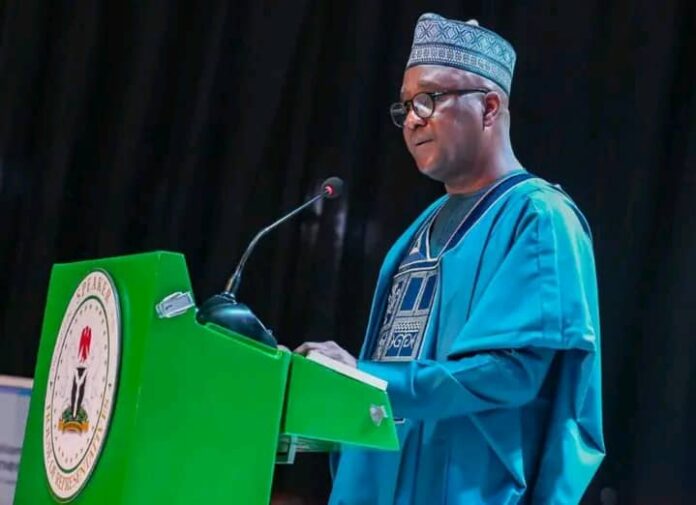

The Speaker of the House of Representatives, Tajudeen Abbas, has urged American investors to explore Nigeria’s investment opportunities, assuring them of efforts to improve security and create a more conducive business environment.
Abbas, represented by the House Majority Leader, Julius Ihonvbere, gave the assurance on Monday in Abuja when a delegation of the United States Chamber of Commerce visited him at the National Assembly.
Acknowledging the challenges of doing business in Nigeria, the Speaker said the country offered significant opportunities across several sectors, supported by its large population, skilled workforce, technical expertise and abundant natural resources.
“People will tell you that Nigeria is a tough place to do business. But those who say so have not been tried before. It’s one of the easiest places to do business. There’s nothing you need that you cannot find here,” he said.
Gbagi Traders Protest Stalled Shops After N2m Payments0:03 / 1:01
Abbas said the administration of President Bola Tinubu was committed to expanding trade with the US and other countries despite the difficulties associated with ongoing economic reforms.
He, however, acknowledged the challenge of translating improvements in national economic indicators into better living conditions for Nigerians at the grassroots.
The Speaker welcomed the extension of the African Growth and Opportunity Act, which grants eligible African countries preferential access to the US market, describing it as an opportunity to strengthen trade and commercial ties between both countries.
On security, Abbas said the situation had improved significantly, citing cooperation between Nigeria and the United States in tackling extremist threats.
He added that the National Assembly had enacted legislation to support businesses and strengthen the capacity of security agencies to protect lives and property.
Abbas urged American companies to look beyond oil and gas and consider investment opportunities in agriculture, healthcare, education, tourism, hospitality, construction, sports, fashion and solid minerals.
He identified agribusiness as a promising area, while pointing to growing demand for hospitality services and the need for world-class medical facilities as opportunities for investors.
The Speaker also encouraged American companies to explore Nigeria’s deposits of lithium, gold and other solid minerals across several states.
He said partnerships with Nigeria’s private sector could help foreign investors understand the local market, establish business networks and identify viable projects.
Abbas urged the delegation to engage Nigerian business leaders and operate within the country’s laws and regulations to build partnerships that would deliver returns for investors while creating jobs and supporting economic growth
Earlier, the President, US Chamber of Commerce’s US-Africa Business Centre, Kendra Gaither, said the delegation was in Nigeria to “strengthen commercial relations and identify practical investment opportunities.”
Gaither said the team would spend three days meeting government officials and industry leaders to advance bankable projects, deepen business partnerships and create jobs in both countries.
She disclosed that the US-Africa Business Centre and the American Business Council Nigeria had established the US-Nigeria Business Initiative to identify sectors in which companies from both countries could collaborate more closely.
Gaither also highlighted opportunities under the African Continental Free Trade Area, saying stronger commercial ties could help Nigerian and American businesses expand their reach across African markets.
She said the delegation was seeking Abbas’s “guidance on strengthening cooperation between the two countries’ business communities and translating their longstanding relationship into tangible economic gains.”
Nigeria and the United States maintain longstanding economic and diplomatic ties, with trade and investment spanning energy, agriculture, technology, healthcare and other sectors. However, concerns over security, infrastructure, foreign exchange volatility and regulatory uncertainty have remained important considerations for businesses operating in Nigeria.
The delegation’s visit comes amid efforts to deepen US-Africa commercial engagement and expand opportunities for private-sector investment.
Turning those discussions into concrete projects will depend on sustained engagement between businesses and government institutions, as well as improvements in the conditions investors face on the ground.
By: Dirisu Yakubu