
By Emmanuel Ndon
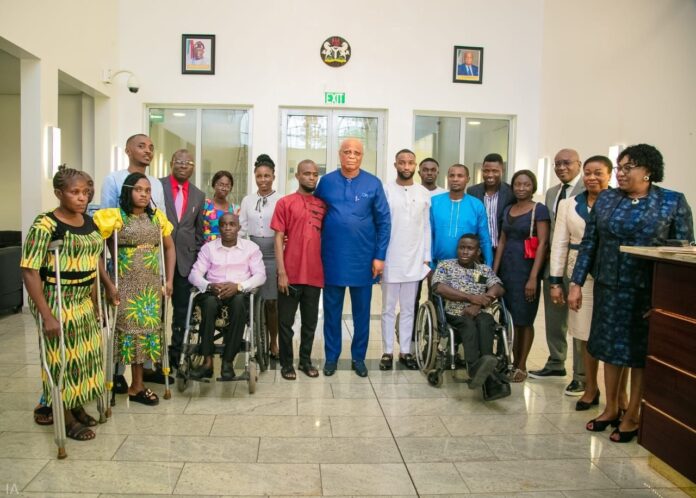
Governor Umo Eno has established a N100 million Education Intervention Fund to support students with disabilities across tertiary institutions in Akwa Ibom State. The initiative provides direct financial assistance to reduce barriers to education and improve academic retention among physically challenged students. Under the ARISE Agenda, the fund targets indigent beneficiaries in public institutions, offering support for tuition and academic needs.
The programme is jointly administered by relevant ministries with financial oversight mechanisms to ensure transparency and proper utilisation. Beneficiaries are verified through institutional and medical documentation before disbursement. Payments are made directly to support educational expenses, ensuring that funds are used for academic continuity rather than diverted through intermediaries.
For students with disabilities, the intervention addresses long-standing financial and accessibility challenges. It enables continuity in academic programmes for students who would otherwise struggle to afford assistive devices, specialised learning tools and basic living expenses. This support strengthens their ability to remain in school and complete their studies without interruption.
The implementation process reflects a coordinated approach to inclusion. Verification procedures, inter-ministerial coordination and direct payment systems are designed to improve accountability and efficiency. This reduces administrative delays and ensures that assistance reaches verified beneficiaries within a defined framework.
Beyond individual support, the programme contributes to broader educational inclusion. It strengthens access to higher education for students with disabilities and encourages institutions to improve accessibility standards. Over time, this fosters a more inclusive academic environment across public universities and polytechnics.
The initiative also has economic and social implications. By supporting students through graduation, it increases the number of skilled individuals who can participate in the workforce. This contributes to long-term productivity and reduces dependency, while also expanding representation of persons with disabilities in professional spaces.
Governor Eno’s approach integrates social welfare with governance reform. The programme is structured to ensure accountability, continuity and measurable outcomes. Regular monitoring and reporting mechanisms are intended to track impact and guide future adjustments.
At the community level, the intervention reinforces the value of inclusive development. Families of beneficiaries experience reduced financial pressure, while communities benefit from increased educational attainment among persons with disabilities. This contributes to a broader culture of equity and participation.
The programme also encourages institutional awareness of accessibility needs. Universities and colleges are increasingly prompted to strengthen support systems, including learning accommodations and infrastructure adjustments that improve participation for students with disabilities.
Ultimately, the N100 million Education Intervention Fund represents a targeted effort of Governor Umo Eno to improve educational access and inclusion for students with disabilities in Akwa Ibom State. By combining financial support with structured accountability, the initiative strengthens academic continuity while advancing a more inclusive educational system.