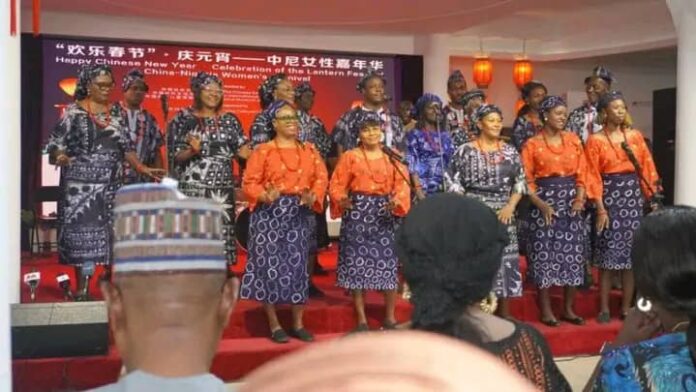

China and Nigeria have reaffirmed the pivotal role of women in driving social development and strengthening bilateral relations, emphasising their vital contributions to societal progress.
Speaking at the Happy Chinese New Year celebration of the Lantern Festival and China-Nigeria Women’s Carnival on Tuesday in Abuja, the Chinese Ambassador to Nigeria, Yang Jianxing, underscored the significance of the event, which coincided with preparations for International Women’s Day.
Jianxing noted that the Chinese New Year was inscribed on UNESCO’s Representative List of the Intangible Cultural Heritage of Humanity at the end of 2024, making it an international festival shared by people all over the world.
Underscoring the importance of the occasion, Jianxing said, “Today is the fifteenth day of the first lunar month in China, which is the Lantern Festival, and in five days, we will celebrate International Women’s Day”.
Highlighting the importance of women in national progress, he stated, “The second theme of today’s event is commemorating International Women’s Day. Women are the bond of families, the cornerstone of society, and a vital force driving social development and progress.
“Whether in China or Nigeria, millions of women are writing extraordinary chapters in their families, workplaces, and national development with resilience, wisdom, and responsibility”.
Speaking further, Jianxing said that over the past three decades China has implemented the Beijing Declaration of the World Conference on Women, resulting in measurable gains.
“Over the past 30 years, China has earnestly implemented the Beijing Declaration of the 1995 Beijing World Conference on Women, effectively protecting women’s rights.
By the time the Global Leaders’ Meeting on Women is held in Beijing in 2025, 690 million women in China have achieved a moderately prosperous society, the maternal mortality rate has decreased by nearly 80%, women account for more than 40% of the total workforce, and women make up more than half of entrepreneurs in the internet sector.
“These figures not only highlight the tremendous development of women’s causes in China, but also demonstrate that without the development of women themselves and their outstanding contributions, China’s current tremendous development would not have been possible,” he said.
Also speaking, the Permanent Secretary of the Federal Ministry of Art, Culture, Tourism and Creative Economy, Dr Mukhtar Muhammad, described the celebration as a fusion of two great cultures.
“We are gathered not just to mark a date on the calendar, but to witness the beautiful fusion of two great cultures at the Lantern Festival and China-Nigeria Women’s Carnival,” he said.
Muhammad emphasised the symbolic importance of the Lantern Festival and women’s empowerment, stating, “as lanterns brighten the night sky, our women light the path of progress. They illuminate the way forward with innovation, they guard the flame of our cultural preservation, and they shine a light on the power of unity,” he said.
He pledged Nigeria’s commitment to expanding cooperation, especially in cultural exchange and women’s empowerment.
“We will implement policies that accelerate our progress in cultural exchanges, that empower our women to lead in the digital economy, and that expand our tourism frontiers,” he said.
Both countries reaffirmed that strengthening women’s access to education and employment remains critical to achieving shared prosperity and advancing their comprehensive strategic partnership.
In his remarks, the Head of Office and Representative of the UNESCO Office Abuja, Jean-Paul Abiaga, underscored the role of culture and education in strengthening ties between Nigeria and China while advancing gender equality.
Abiaga said the gathering went beyond festivity. “It is a living testament to the power of culture and education to build bridges between two great nations, Nigeria and China and to the enduring dialogue of civilisations that lies at the very heart of UNESCO’s mandate.”
Abiaga said a society moves forward when women and girls are empowered. Highlighting progress in gender inclusion.
He observed that both China and Nigeria, as influential global actors and major economies, have made meaningful strides in advancing gender equality.
Deborah Musa