
By Ekaette Okon-Joseph
N743 billion.
That is the amount Akwa Ibom State has committed to road infrastructure in just three years, a figure that reflects the scale of Governor Umo Eno’s ambition to transform transportation into a catalyst for economic growth, investment attraction and tourism development. Across the state, more than 1,300 kilometres of roads and over 40 bridges are reshaping how people, goods and opportunities move, laying the foundation for what is increasingly emerging as one of Nigeria’s most connected subnational economies.
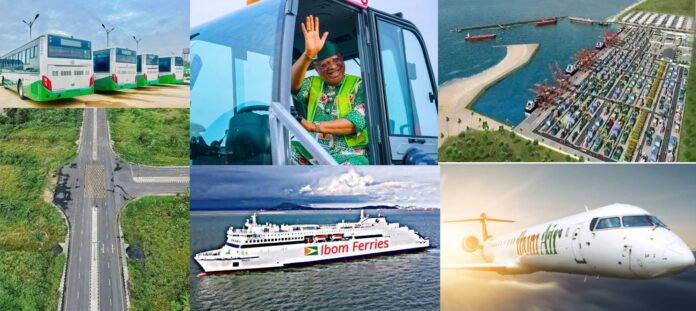
From the commercial streets of Uyo to the coastal communities of Oron and the agricultural belts of the state’s hinterland, transportation infrastructure is becoming the economic language of the ARISE Agenda. Roads are opening access to markets. Aviation investments are strengthening regional connectivity. Marine infrastructure is expanding opportunities for trade and tourism. New mass transit projects are being developed to improve mobility and reduce transportation costs.
For Governor Umo Eno, the investments represent more than construction projects. They are strategic economic assets designed to unlock growth across multiple sectors.
Speaking during activities marking the third anniversary of his administration, the governor said transportation development remains a central pillar of the ARISE Agenda because of its ability to stimulate commerce, improve productivity and create opportunities for citizens.
Eno disclosed that the administration has commissioned and commenced approximately 1,300 kilometres of economically viable roads and more than 40 bridges across the state. He explained that the projects were deliberately designed to connect rural communities to urban centres, improve the movement of agricultural produce and facilitate commercial activities across Akwa Ibom.
The governor noted that infrastructure remains one of the strongest drivers of economic transformation, adding that improved transportation networks help communities gain access to markets, schools, healthcare facilities and investment opportunities.
The scale of the administration’s commitment is evident across the state’s transportation landscape.
Commissioner for Works, Professor Eno Ibanga, disclosed that the government has committed approximately N743 billion to road construction projects, describing the investment as a reflection of the administration’s determination to provide durable infrastructure capable of supporting long-term economic growth.
Among the completed projects are the reconstruction of the 14.3-kilometre Ikot Ubo to Odot Road in Nsit Ubium and Nsit Atai, internal roads at the Police Headquarters in Ikot Akpan Abia, underground drainage infrastructure in Uyo, the completion of the Ikot Esu to Otomo to Azumini Road in Ika, the Pepsi Junction in Uyo to Ukpom- Abak Road and the expansion of the Oron Road corridor leading to Victor Attah International Airport.
Several strategic projects are also progressing across the state, including the dualisation of Ring Road III, reconstruction of the Ikot Akpaden to Iko Road with bridges, the dualisation of the Okopedi to Oron Road and multiple road projects spanning Uyo, Itu, Ibiono Ibom, Ikono, Ikot Ekpene, Mkpat Enin, Obot Akara and other local government areas.
For investors, transportation infrastructure often serves as a critical indicator of economic readiness. Efficient road networks reduce logistics costs, improve market access and increase the attractiveness of a destination for manufacturing, agriculture, logistics, hospitality and commercial enterprises.
Commissioner for Information, Rt. Hon. Aniekan Umanah, has consistently maintained that infrastructure development remains one of the strongest pillars of the ARISE Agenda. According to him, investments in roads, transportation and public infrastructure are laying the foundation for a more competitive economy while creating opportunities for sustainable growth and development.
The administration’s transportation vision extends beyond roads.
In the aviation sector, Akwa Ibom has continued to strengthen its position as a regional gateway for business and tourism. Governor Eno highlighted the successful operation of the state’s maiden international flight from the new terminal building of Victor Attah International Airport to Accra, Ghana, describing it as a major milestone in Akwa Ibom’s journey toward becoming a preferred destination for investment and tourism.
The state-owned carrier, Ibom Air, has equally expanded its operational capacity. The administration has acquired and fully paid for two CRJ900 Bombardier aircraft, while an Airbus A220-300 is expected to join the fleet. Supporting investments in the Aviation Village, Maintenance, Repair and Overhaul, (MRO)facility, airport taxiway expansion, perimeter fencing and airport corridor development are further strengthening the state’s aviation ecosystem.
Beyond aviation, the government is investing in modern public transportation. Governor Eno recently announced that the first batch of 50 Compressed Natural Gas buses will arrive in June as part of efforts to establish a modern, affordable and environmentally sustainable transportation system. Construction is also progressing on a major bus terminal in the State capital, expected to significantly improve passenger movement and urban mobility.
The state’s maritime sector is equally receiving attention. The ongoing reconstruction of the Oron Marine Terminal and jetties is expected to strengthen marine transportation, facilitate trade and unlock new opportunities within the tourism economy.
Together, these investments are creating what development experts describe as a multimodal transportation network, a system in which road, air and water transportation operate in synergy to support economic expansion and competitiveness.
The impact of these projects is already being felt by residents.
Mrs. Atim Godwin, a trader at Akpan Andem Market in Uyo, recalled the challenges associated with poor road conditions in parts of the market. She said movement has become easier following improvements to surrounding roads, making business activities more convenient for both traders and customers.
Mr. Jimaima Essien, a United Kingdom-based mental health expert, also commended Governor Eno’s infrastructure investments. According to him, improved road networks will help attract investors to the State by enhancing accessibility and demonstrating the government’s commitment to long-term development.
Tourism stakeholders see similar opportunities. A destination may possess rich culture, hospitality assets, beaches and natural attractions, but accessibility often determines its competitiveness. Through investments in roads, aviation, marine facilities and public transportation, Akwa Ibom is steadily creating the infrastructure required to unlock its full tourism potential.
Three years into the ARISE Agenda, the emerging picture is becoming increasingly clear. Roads are connecting communities. Bridges are linking economic corridors. Aircraft are opening regional markets. Marine facilities are expanding coastal opportunities. Modern transit systems are improving mobility.
Together, they form the transportation backbone of a state that is steadily positioning itself as one of Nigeria’s most attractive destinations for investment, tourism and economic growth.
The story unfolding across Akwa Ibom is therefore not simply about concrete, asphalt, bridges or aircraft. It is about creating the systems that move economies forward. In building the infrastructure that connects people, markets and opportunities, the Umo Eno led administration is also building pathways to prosperity and laying a solid foundation for a more competitive future.