

By Pakute
NIGCOMSAT is expanding Nigeria’s space capabilities through new satellites, startup support, and nationwide connectivity initiatives.
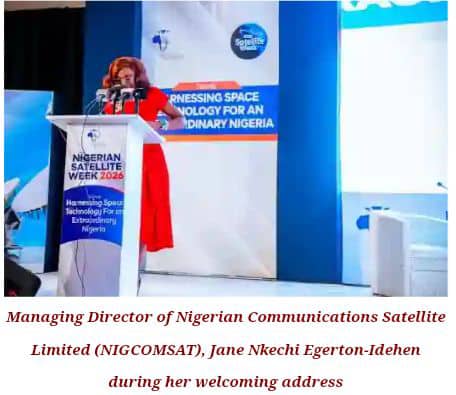
President Bola Tinubu has approved two additional communication satellites, NIGCOMSAT 2A and 2B, for Nigeria’s space programme, the Managing Director of Nigerian Communications Satellite Limited (NIGCOMSAT), Jane Nkechi Egerton-Idehen, announced on Monday.
She disclosed this during her welcoming address at the opening of the 2026 Nigerian Satellite Week in Abuja, themed “Harnessing Space Technology for an Extraordinary Nigeria.”
“This approval by President Bola Ahmed Tinubu is a clear demonstration of Nigeria’s recognition of space as a driver of national development and sovereignty,” Mrs Egerton-Idehen said.
Reflecting on the agency’s journey, Mrs Egerton-Idehen said NIGCOMSAT has grown from a single-satellite operator into a multi-service provider offering broadband, broadcasting, and connectivity services across Nigeria and parts of Africa.
“Twenty years ago, Nigeria declared its readiness to participate and shape one of the most consequential industries of this century. That declaration was not abstract; it was a commitment to build capacity, institutions, and credibility in the global space economy,” she said.
[b]The MD also spoke about NIGCOMSAT’s strengthened global and regional presence, adding that the agency recently secured a Low Earth Orbit connectivity partnership with Eutelsat and initiated cooperation with the Kenya Space Agency.
It now holds the Vice Chairmanship of the Global Satellite Operators Association, giving Nigeria influence in international satellite policy and spectrum governance.
Mrs Egerton-Idehen highlighted initiatives aimed at nurturing the next generation of space-focused companies.
She said the NIGCOMSAT Accelerator Programme, launched this year, will become a permanent feature to support startups working in satellite applications and digital connectivity.
Complementing the accelerator programme is Project 774, designed to extend satellite-enabled connectivity to all local government areas across Nigeria, supporting healthcare, education, and economic activity in underserved communities.
“Today, the work of building Nigeria’s space future is being done here, by the institutions, innovators, investors, policymakers, and stakeholders gathered in this room,” Mrs Egerton-Idehen noted.
Kennedy Osemwegie, representing the Chief of Army Staff, said satellites now support intelligence gathering, surveillance, communications, and disaster response.
He added that collaboration between the military, government agencies, and private sector actors has enhanced Nigeria’s capacity for satellite-enabled operations, which are critical for addressing terrorism, insurgency, and cross-border crimes.
On his part, the Executive Vice Chairman of the Nigerian Communications Commission (NCC), Aminu Maida, emphasised the role of satellites in expanding Nigeria’s digital infrastructure.
Satellite technology, he said, is central to improving connectivity, service quality, and access across sectors, including education, healthcare, and emergency response.
He stressed the need for collaboration between the government, the private sector, and innovators to develop practical solutions that strengthen Nigeria’s space and digital ecosystem.
Speaking on the first day’s theme, “The Space Race: The Convergence of Technology, Government, and Opportunities,” the Minister of Communications, Innovation and Digital Economy, Bosun Tijjani, reaffirmed the government’s commitment to expanding satellite infrastructure and praised President Tinubu’s approval of the new satellites.
“When a community gains the opportunity to connect, it transforms how businesses operate and how people live. Satellite technology allows us to extend connectivity to places where other infrastructure cannot reach. It also provides resilience, innovation, and strengthens our digital economy,” the minister said.
He added that fostering innovation through research, partnerships, and startup engagement is essential to developing solutions for agriculture, education, commerce, and security.
Mr Tijjani emphasised that Nigeria’s space leadership carries a continental responsibility.
“Nigeria’s leadership in satellite technology is not just for Nigeria. It is for Africa. We must build talent that understands both the technology and its applications. We must create room for businesses to grow in this space. And we must collaborate more across the continent,” he added.
The event brought together policymakers, government agencies, technology innovators, investors, academics, and other experts, providing a platform for dialogue, partnerships, and practical solutions to advance Nigeria’s space and digital economy.