
By innocent Odoh
The Federal Government has said that the evacuation of Nigerians, estimated to be in the tens of thousands, from the troubled Middle East, especially the Gulf region, may not be possible at present following the closure of all airspace in the region due to the raging war that the United States and Israel launched on Iran on Saturday.
An Israeli strike on the presidential compound in the Iranian capital, Tehran, on Saturday reportedly killed the Supreme Leader of the Republic, Ayatollah Ali Hossein Khamenai, and about 30 top officials of the regime.
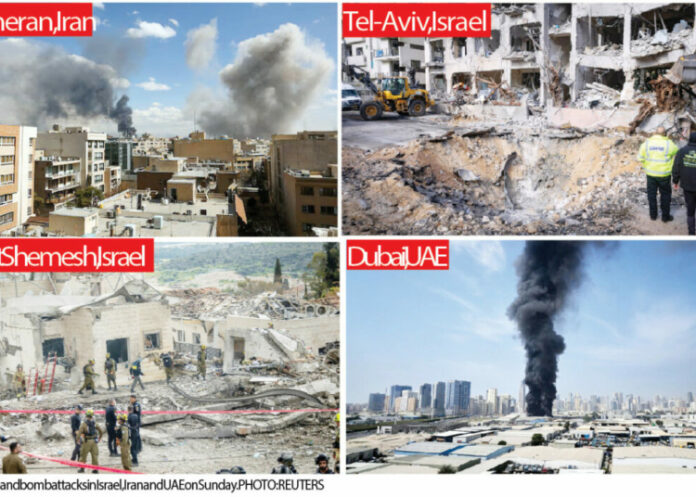
Iran retaliated by attacking Israel and US military bases in Gulf States such as Bahrain, the United Arab Emirates (UAE), Qatar, Saudi Arabia, Kuwait and Jordan, among others, escalating tension in the region.
Spokesman for the Nigerian Ministry of Foreign Affairs, Kimiebi Ebienfa, told LEADERSHIP on Sunday that although the Federal Government often has plans to evacuate Nigerians from troubled spots, the process may have to wait until the situation improves, stressing that the government is “monitoring the situation
An Israeli strike on the presidential compound in the Iranian capital, Tehran, on Saturday reportedly killed the Supreme Leader of the Republic, Ayatollah Ali Hossein Khamenai, and about 30 top officials of the regime.
Iran retaliated by attacking Israel and US military bases in Gulf States such as Bahrain, the United Arab Emirates (UAE), Qatar, Saudi Arabia, Kuwait and Jordan, among others, escalating tension in the region.
Spokesman for the Nigerian Ministry of Foreign Affairs, Kimiebi Ebienfa, told LEADERSHIP on Sunday that although the Federal Government often has plans to evacuate Nigerians from troubled spots, the process may have to wait until the situation improves, stressing that the government is “monitoring the situation”.
The spokesman also told our correspondent that one Nigerian was injured in the Iranian missile attack on Kuwait but has since been treated and remains stable.
He admonished Nigerians resident in the Gulf state to adhere to the security advisory issued by the government on Saturday.
Analysts have expressed fears that a wounded and leaderless Iran might become more desperate, as it has vowed to continue its missile attacks on the US, Israel and Gulf countries suspected of offering support to the Americans and the Israelis, now that their spiritual leader has been killed.
Meanwhile, the African Union (AU) and the Economic Community of West African States (ECOWAS) have called on all parties to the conflict to exercise restraint and de-escalate the crisis in the interest of global peace.
The Chairperson of the African Union Commission, H.E. Mahmoud Ali Youssouf, in a statement on Saturday expressed deep concern over the military strikes carried out by the United States in coordination with Israeli forces against targets inside the Islamic Republic of Iran, an escalation that marks a serious intensification of hostilities in the Middle East.
The chairperson called for restraint, urgent de-escalation and sustained dialogue, stressing that all parties must act fully in accordance with international law and the United Nations Charter to safeguard international peace and security.
The Chairperson also warned that further escalation threatens to worsen global instability, with serious implications for energy markets, food security and economic resilience — particularly in Africa, where conflict and economic pressures remain acute.
He urged all concerned actors to prioritise diplomatic engagement, including ongoing international mediation efforts facilitated by the Sultanate of Oman, to prevent further deterioration and uphold the international rules-based order.
Mr Youssouf reiterated that sustainable peace can only be achieved through diplomacy, not through force.
In a similar development, ECOWAS, under the chairmanship of President Julius Maada Bio of Sierra Leone, aligned itself with the statement of the African Union Commission and expressed deep concern over escalating hostilities in the Gulf region.
The ECOWAS Chair, in a statement on Sunday, warned that the intensification of military action risks widening instability in the Middle East, with serious consequences for international peace and security in general and for global energy markets, trade and food supply chains, especially for Africa and other vulnerable regions.
ECOWAS therefore called on all parties to exercise maximum restraint and act in full compliance with the United Nations Charter and international law, particularly the principles of sovereignty, territorial integrity and the peaceful settlement of disputes.
“The protection of civilian lives and critical infrastructure must remain paramount,” the statement said.
ECOWAS further called for renewed diplomatic efforts within established international and regional frameworks in order to promote dialogue, reduce tensions and restore stability.
Meanwhile, the Nigerian embassy in Kuwait issued a safety advisory on Sunday to Nigerians living in the country and in Bahrain, urging them to remain vigilant.
In a circular released on Sunday and made available to reporters by Abdulkadir Alkasim, Special Adviser on Media to the Nigerian Minister of Foreign Affairs, Yusuf Tuggar, the government said it has created a dedicated mobile and WhatsApp line for enquiries and updates, and urged Nigerians to utilise the contact channel for verified information and assistance.
For enquiries, nationals may reach the embassy via email at nigeriakuwait@yahoo.com or through the designated WhatsApp number +96599238835.
IGP Orders Strict Surveillance
The Inspector-General of Police, Ag. IGP Olatunji Disu, has ordered strict surveillance across Nigeria, especially in the North West, North East and North Central zones, following the escalating situation in the Middle East.
The Nigeria Police Force reiterated that Nigeria will not serve as a theatre for foreign conflicts. Any attempt to import external ideological or religious tensions into the country will be met with the full weight of the law.
IGP Disu called on community leaders nationwide to continue promoting peace and urged citizens to remain calm, vigilant and law-abiding, reporting any suspicious activity to the nearest police formation.
He reassured all Nigerians of the unwavering commitment of the Nigeria Police Force to the protection of lives, property and national peace, in light of evolving geopolitical tensions in the Middle East and their potential global implications.
Force PRO, ACP Benjamin Hundeyin, said that while Nigeria remains stable and its internal security situation firmly under control, the Force has reinforced proactive, intelligence-led policing measures across the country.
According to him, “The Ag. IGP has directed all commissioners of police in the 36 states and the Federal Capital Territory, with particular attention to the North West, North East and North Central zones, to heighten surveillance and intelligence gathering, strengthen collaboration with traditional and religious leaders, enhance visibility policing around worship centres and public spaces, and swiftly address any attempt by individuals or groups to exploit global developments to incite unrest or sectarian tension.”
He noted that the Nigeria Police Force remains resolute, prepared and fully committed to safeguarding every Nigerian and maintaining national security at all times.
FIFA Faces Diplomatic Minefield As US-Iran-Israel Conflict Casts Shadow Over 2026 World Cup
As the 2026 FIFA World Cup draws nearer, the global football community is grappling with an increasingly precarious geopolitical climate. Recent military actions involving the United States, Iran and Israel have ignited serious concerns, particularly regarding the Iranian national football team’s participation in the tournament, co-hosted by the United States, Canada and Mexico.
Iran, having successfully qualified, now faces an uncertain future amid escalating international tensions.
FIFA, football’s global governing body, has publicly acknowledged the gravity of the situation, stating it will “monitor developments” closely following the outbreak of hostilities. The announcement by US President Donald Trump of missile strikes against Iran, labelled a “major combat operation”, has cast a significant shadow over Iran’s scheduled matches.
Critically, Iran is slated to play all three of its group-stage games on American soil, with key fixtures against Belgium and New Zealand in Los Angeles, and Egypt in Seattle. The prospect of these matches proceeding as planned now appears increasingly tenuous.
Amid mounting political pressure, the Iran Football Federation (IFF) has openly announced the possibility of withdrawing from the tournament. IFF President Mehdi Taj, in a televised address, conveyed that the ongoing conflict and recent US military actions have created profound concerns that now overshadow the excitement of participating in the World Cup.
He confirmed that the ultimate decision regarding Iran’s involvement would rest with the country’s highest sports officials, underscoring the severe nature of the predicament.
A potential Iranian withdrawal would carry profound implications for the tournament. It would not only disrupt the carefully constructed group dynamics but also significantly diminish the competitive spirit and global representation that define the World Cup.
FIFA Secretary-General Mattias Grafstrom echoed these anxieties, stating, “Our focus is on a safe World Cup with all the teams participating.” However, ensuring safety and participation amidst an active military conflict presents an extraordinary and daunting challenge for the organisers.
Adding to the complexities of the World Cup preparations, security issues have also emerged in Mexico, one of the host nations. Following the death of notorious cartel leader “El Mencho” during a military operation, the city of Guadalajara experienced violent unrest, leading to widespread public transport suspensions and acts of vandalism. Such domestic disturbances present additional logistical and security challenges for FIFA as it strives to provide a secure and welcoming environment for millions of fans and players alike.
The ripple effects of this international instability have already impacted domestic football in Iran, with the national federation suspending league matches until further notice. This decision has directly affected numerous foreign players within the Iranian league, prompting many to seek safe passage out of the country.
This interconnectedness of sport and international relations highlights how geopolitical tensions can rapidly disrupt sporting events on a global scale, demonstrating that even the “beautiful game” is not immune to real-world crises.
As preparations for the World Cup continue, the spectre of conflict looms large over the tournament. FIFA’s commendable commitment to ensuring a safe and enjoyable event is being tested by the undeniable realities of the US-Iran-Israel conflict. The profound uncertainty surrounding Iran’s participation not only threatens the integrity of the tournament but also serves as a stark reminder of how global politics can permeate and overshadow even the most celebrated sporting events.
In the crucial months leading up to the World Cup, it remains imperative for FIFA and the host nations to navigate these turbulent waters with the utmost diplomacy and caution. The world will be watching intently, not only for the unfolding drama on the pitch but also for how the broader geopolitical landscape evolves in the lead-up to one of football’s most prestigious and eagerly anticipated tournaments.