
By Emmanuel Ndon
Legislatures are judged primarily by the quality of their laws, debates and oversight. Yet the buildings from which they operate also influence how effectively those responsibilities are carried out. Chambers, committee rooms, offices and supporting facilities are not simply physical structures. They form part of the institutional environment within which democratic governance takes place.
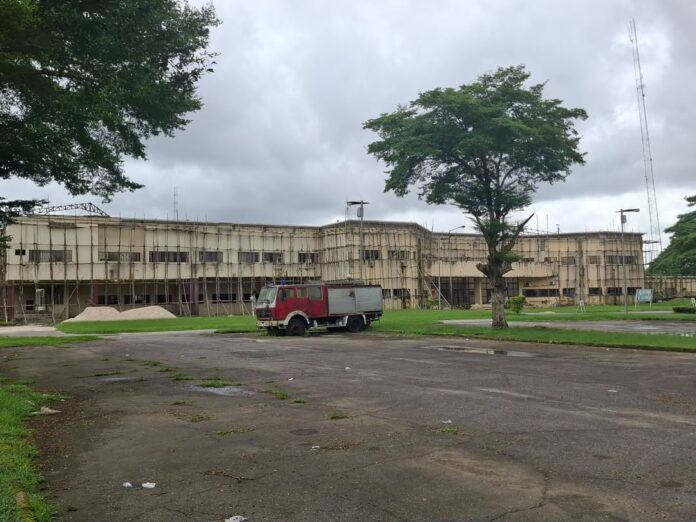
The ongoing renovation of the Akwa Ibom State House of Assembly Complex reflects this often overlooked aspect of public infrastructure. Being executed under Governor Umo Eno’s administration, the project seeks to modernise the physical environment of one of the state’s most important democratic institutions while preserving its capacity to serve present and future legislative needs.
Public buildings that experience daily use inevitably deteriorate over time. Continuous occupation, changing operational requirements and advances in workplace standards mean that periodic renovation becomes necessary to maintain safety, functionality and efficiency. Legislative complexes are no exception, particularly as they accommodate elected representatives, legislative staff, government officials, stakeholders and members of the public throughout the year.
Renovation goes beyond improving appearance. Upgraded office accommodation, improved committee rooms, modern utility systems and better working facilities contribute to a more efficient legislative environment. They support committee work, policy discussions, public hearings and the administrative functions that enable a legislature to perform its constitutional responsibilities.
The project also reflects an important principle of Governor Umo Eno’s ongoing infrastructure programme: that preserving existing public assets is as essential as delivering new ones. Rehabilitating existing infrastructure is often more cost-effective than allowing facilities to deteriorate to the point where extensive reconstruction becomes necessary. Timely maintenance protects public investment while extending the useful life of government facilities.
Members of the public also benefit from improvements to legislative infrastructure. Citizens, civil society organisations, professional bodies and community groups regularly engage with the House of Assembly through committee hearings, consultations and other official proceedings. A functional legislative complex provides a more suitable environment for these interactions and supports greater institutional accessibility.
Workplace standards have also evolved considerably in recent years. Modern public buildings are expected to provide more reliable electrical systems, improved safety features, enhanced accessibility and working environments that support productivity. Renovation offers an opportunity to align older facilities with these contemporary expectations.
The significance of the project extends beyond the Assembly complex . Well-maintained legislative infrastructure reinforces the continuity of democratic institutions by ensuring that the physical environment does not become a constraint on legislative business. It allows governance to proceed within facilities that are appropriate for the responsibilities they accommodate.
Across many jurisdictions, investment in parliamentary and legislative buildings forms part of broader institutional development. Governments recognise that effective governance depends not only on laws and public policies but also on maintaining the infrastructure that enables institutions to function efficiently. The current Akwa Ibom State Government’s decision to renovate the Assembly complex reflects this broader understanding of institutional development.
The ongoing renovation of the Akwa Ibom State House of Assembly Complex should therefore be viewed as more than a construction project. It represents continued investment in an institution that plays a central role in lawmaking, representation and oversight within the state’s constitutional framework.
As work progresses, the renovated complex is expected to provide a more functional and durable environment for legislative activities. Beyond improving the physical structure, the project reinforces Governor Umo Eno’s administration’s commitment to strengthening the public institutions through which governance is conducted, ensuring that the state’s legislature operates within facilities that are fit for the responsibilities entrusted to it.