
By Emmanuel Ndon
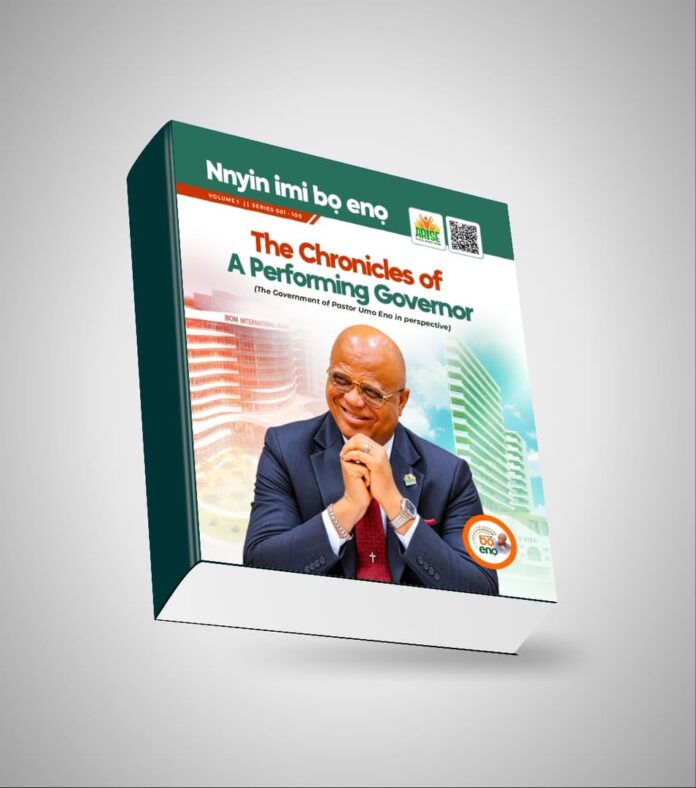
Over time, the progress, developments and overall impact of a government, accumulated across years and sectors, become increasingly difficult to trace. For this reason, a forthcoming three-volume publication, “The Chronicles of a Performing Governor: The Government of Pastor Umo Eno in Perspective,” attempts to bring together as much of the impact of Governor Umo Eno’s administration as possible in one organised archive.
Bearing the head title “Nnyin imi bọ eno” the publication is structured in three volumes that examine Governor Umo Eno’s administration and its impact across Akwa Ibom State.
The publication’s value lies in its attempt to connect stories that might otherwise remain isolated. A road project, school intervention, hospital development, industrial revival or worker welfare programme may each appear as a separate account when reported individually. Placed within a chronological record, however, they offer a clearer view of the scale, range and direction of an administration’s activities.
The content of the archive ranges across various sectors, including infrastructure, education, healthcare, agriculture, industry, employment, transportation, tourism and public-sector development. Bringing these stories together allows readers to examine not only what was undertaken but also how the different interventions have unfolded over time.
The three-volume structure also gives the publication a documentary character. Rather than reducing the administration to a political biography or a selective catalogue of achievements, it brings together developments from different sectors to show how they collectively reflect the administration’s approach and commitment to good governance under the A.R.I.S.E agenda
There is a historical value to such documentation. Projects evolve, institutions change and administrations eventually give way to others. A written record provides future researchers, journalists, students and citizens with material through which a particular period can be examined from the perspective of the events as they unfolded. The publication therefore has relevance beyond the immediate political moment.
Its subtitle, “The Government of Pastor Umo Eno in Perspective,” is equally important. Perspective means looking beyond a simple list of projects and achievements. It places developments within their circumstances and evaluates what they mean for people, institutions and the wider economy. In that sense, the chronicle seeks to document not only what the administration did but also the general story emerging from those actions.
For Governor Umo Eno’s administration, this creates a consolidated view of how individual interventions contribute to a wider development narrative. A factory revival, road project, education intervention or worker welfare measure may respond to a specific need, but together such initiatives reveal the priorities and choices shaping a government.
The publication also captures an administration while its story is still unfolding. That contemporaneity gives it a distinctive historical value, preserving developments close to the period in which they occurred rather than reconstructing them years later from fragmented records.
With three volumes bringing together the chronicles of the administration, “The Chronicles of a Performing Governor” offers readers a comprehensive account of the policies, projects and public interventions that have defined Governor Umo Eno’s administration. Its forthcoming unveiling will therefore mark another stage in the life of the series: from stories published over time to an archive that can be read as a whole.
For readers who have followed the article series, the volumes will offer an opportunity to see familiar stories in a wider context. For new readers, they provide an organised entry point into the administration and the developments associated with it. Its enduring value, however, will rest on its ability to preserve a record that can be read, referenced and revisited long after the individual moments it documents have passed.