
By Lucy Daniel
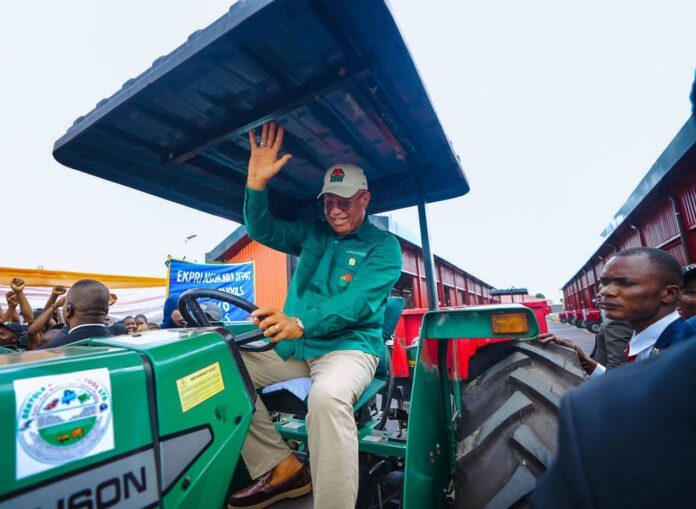
The usually quiet community of Ekpri Nsukara came alive yestetday, as the Ibom Agricultural Equipment Leasing Facility was officially commissioned, marking a major milestone in the drive by Umo Eno to shift agriculture in Akwa Ibom State from labour-intensive, subsistence practices to a modern, mechanized and commercially driven sector.
At first glance, it looked like just another government commissioning, white canopies, dignitaries in flowing attires, and the hum of official speeches. But beneath the ceremonial gloss was something far more consequential: a quiet revolution in how farming is done in Akwa Ibom State.
When Umo Eno stepped forward to inaugurate the facility, he wasn’t merely unveiling a structure of steel and engines. He was drawing a clear line between the past and the future of agriculture in the state.
For decades, farming across much of southern Nigeria has been defined by subsistence, small plots, crude tools, and unpredictable yields. But standing before a fleet of gleaming tractors and mechanized implements, Governor Eno made it clear that, that era is being deliberately phased out.
“This facility is primed to help our farmers move from peasant farming to commercial-scale production. Agriculture must no longer be seen as a subsistence venture, but as a business with strong economic returns,” he declared.
The Ibom Equipment Leasing Facility is a practical expression of the ARISE Agenda, an economic blueprint that places food security, affordability, and productivity at its core.
The scale of the project underscores its ambition. The facility features tractor sheds for equipment storage and deployment, administrative buildings for operations, a fully equipped maintenance workshop, a fleet of 25 tractors with attachable implements, two low-bed trailers for transportation, a fuel dump, access roads, and storage facilities, all designed to support seamless, large-scale agricultural operations.
Here, policy meets practice. Farmers and cooperatives can lease modern equipment for land preparation, access technical support, and operate within a system designed for efficiency. By subsidizing leasing costs by over 50 per cent, the state government has significantly lowered the barrier to entry, making mechanization accessible to a broader spectrum of farmers. While users are responsible for fueling the machines, the on-site fuel dump ensures quality control and protects the equipment from damage caused by adulterated fuel.
It is not just about machines, it is about building a system that works, one that reflects the broader ambition of the ARISE Agenda to create sustainable livelihoods, drive inclusive growth, and reposition Akwa Ibom as a major agricultural hub.
Beyond its immediate utility, the economic significance of the facility is far-reaching. Mechanization reduces production costs, shortens cultivation cycles, and increases yield per hectare, factors that directly influence food prices and farmers’ incomes.
By cutting land preparation costs, previously as high as ₦150,000 per hectare, the facility is positioned to ease production expenses, improve profitability for farmers, and ultimately contribute to more stable food prices across the state. Increased output also strengthens food supply chains, stimulates agro-processing industries, and creates employment opportunities across farming, logistics, maintenance, and distribution.
Globally, similar models have transformed agricultural economies. In Brazil, large-scale mechanization helped convert vast rural landscapes into highly productive agricultural zones, while in India, equipment leasing schemes have enabled small holder farmers to scale production without the burden of ownership. The Ibom model reflects these proven approaches, adapted to local realities, where access, affordability, and support systems drive transformation.
For many farmers in Akwa Ibom, the event represented more than the unveiling of a government project. It signaled a long-awaited shift from the limitations of manual farming to a future defined by efficiency, scale, and improved productivity.
“I’ve been farming cassava for over 15 years,” said Emmanuel Udo, a cooperative member from Ini Local Government who witnessed the unveiling. “Before now, clearing one hectare could take weeks. With these machines, it can be done in a day. That changes everything, cost, time, even how much we can produce.”
A young agripreneur, Blessing Etim, echoed the sentiment from a generational perspective. “People my age often shy away from farming because it’s too stressful. But when you see this level of mechanization, you begin to think differently. It starts to look like a real business.”
Their testimonies, shared in the open field as tractors revved in demonstration, captured the human dimension of what might otherwise be seen as infrastructure.
Adding the voice of the host community, Etteidung Emem Asikpo, Village Head of Ekpri Nsukara Offot, expressed deep appreciation:
“I greet His Excellency and his entourage and express my happiness over this project. To witness this remarkable development in my lifetime is a blessing. We promise to protect it. Please continue in your work, we have seen what you have done. May the Lord strengthen you till 2031.
“We also have erosion challenges here, and we plead for additional roads in Ekpri Nsukara for easy access.”
For commercial farmers, the economic implications were unmistakable. Hogan Bassey, representing industrial farmers, offered a grounded perspective:
“Many people may not fully understand what is here. To prepare one hectare of land can cost as much as ₦150,000. With this facility, that cost will come down. We even have planters here.
“Let everyone see this as personal property so we can maintain it. It’s not just tractors, we also have a maintenance section to keep everything running. God bless His Excellency.”
Earlier, goodwill messages from stakeholders further reinforced the sense of collective ownership. The Paramount Ruler, Edidem Sylvanus E. Okon; Mr. Monday Eyo; and other representatives commended the administration’s achievements and pledged continued support and collaboration.
Beyond equipment, the initiative is anchored on knowledge. The engagement of Akwa Ibom State University to manage the Ibom Model Farms and greenhouses along Airport Road introduces a research-driven layer to the state’s agricultural transformation.
The Governor disclosed that the management of the Ibom Model Farm and greenhouses would be transferred to the University’s Faculty of Agriculture, with provisions to accommodate its leadership within the facility, strengthening research, training, and innovation.
This collaboration ties innovation to real-world application, ensuring that mechanization is supported by scientific knowledge and best practices.
Earlier, the Commissioner for Agriculture, Dr. Offiong Offor, described the commissioning as a milestone in repositioning the sector for productivity and sustainability. She noted that the tractors are fitted with tracking devices to ensure accountability and efficient usage, while additional logistics support, including low-bed trailers, enhances operational reach.
The facility’s Manager, Engr. Ifiok Ekot, assured stakeholders of effective management, pledging measurable progress within a short period and a mid-year performance report.
Governor Eno also commended Engr. Loye Ogar and her construction team for delivering what he described as a state-of-the-art facility, highlighting her professionalism and dedication as emblematic of excellence.
What stands today at Ekpri Nsukara is more than infrastructure, it is a statement.
It signals a shift from effort-intensive farming to efficiency-driven agriculture; from uncertainty to planning; from subsistence to scale.
Beyond its immediate impact, the project reflects a governing philosophy anchored on measurable results. Within the broader framework of the ARISE Agenda, initiatives like this underscore a deliberate attempt to tackle food insecurity, empower farmers, and stimulate rural economies. For many observers and stakeholders, the visible outcomes, combined with growing confidence among farmers and communities, form part of the argument for sustaining the current trajectory of leadership beyond a single term.
As the ceremony drew to a close, the tractors, once lined up for inspection, roared to life, cutting into the soil in a live demonstration. It was a simple act, but deeply symbolic.
For those present, it was more than the commissioning of a facility. It was the sound of agriculture in Akwa Ibom changing course, powered by vision, backed by structure, and already being felt by the people it is meant to serve.


Related articles